How to Build a Danielson Evidence Binder for NYC Advance Observations
By David's Data Warehouse · · 5 min read
If you teach in New York City, your Measures of Teacher Practice (MOTP) rating comes from observations scored on the Danielson Framework for Teaching under Advance. Observations happen whether or not you are organized, but an evidence binder changes the conversation at your conferences. Instead of trying to remember what you did in October, you can point to dated artifacts, feedback you received, and the next steps you acted on.
This guide explains what to put in a Danielson evidence binder, how to organize it around the components that are actually rated in NYC, and how to keep it up to date in about ten minutes a week.
Advance policies change from year to year. Always confirm current requirements with your school leaders, the NYC Public Schools Advance guidance, and your union. This site is independent and is not affiliated with NYC Public Schools or The Danielson Group.
What an evidence binder is (and isn't)
An evidence binder is your own organized record of practice: lesson plans, student work, assessment data, family communication logs, and professional learning, each filed under the Danielson component it shows. It is not an official form, and nothing requires you to keep one. It also does not replace your evaluator's evidence. What it does is make it easy to:
- prepare for your Initial Planning Conference (IPC) and your end-of-year conference,
- notice which components have little or no evidence before the spring observation window,
- track the feedback and ratings you receive after each observation, and
- show growth over the year, which is the whole point of component 4e.
The 8 components rated under NYC Advance
The full Framework for Teaching has 22 components across four domains: Planning and Preparation, the Classroom Environment, Instruction, and Professional Responsibilities. Under Advance, NYC evaluators rate a smaller set. For school year 2025-26, Advance policy summaries list eight rated components:
- 1a: knowledge of content and pedagogy
- 1e: designing coherent instruction
- 2a: respect and rapport
- 2d: managing student behavior
- 3b: questioning and discussion
- 3c: engaging students in learning
- 3d: using assessment in instruction
- 4e: growing and developing professionally
The labels above are short paraphrases. Use your district's official rubric for the exact component titles and performance-level language. The 2025-26 policy summary also notes that evaluators may consider evidence from shortly before an observation for 1a, 1e and 4e. That makes planning documents and professional learning records especially worth keeping.
Evidence ideas for each rated component
Good artifacts are specific, dated, and connected to students. Here are practical examples teachers commonly collect:
- 1a (content and pedagogy): a unit plan that names prerequisite skills and likely misconceptions; notes from a content workshop you applied in a lesson.
- 1e (coherent instruction): a unit calendar showing how lessons build toward an end task; a lesson plan with grouping decisions explained.
- 2a (respect and rapport): a class agreements chart students helped write; an interest survey and how you used the results.
- 2d (student behavior): your posted expectations and the routine for teaching them; a short reflection on how you adjusted a behavior system.
- 3b (questioning and discussion): a discussion protocol, question stems, or a short transcript excerpt showing students responding to each other.
- 3c (engagement): a task where students did the thinking, with samples of student work at different levels.
- 3d (assessment in instruction): exit tickets sorted into groups and the reteach plan that followed; a self-assessment checklist students used.
- 4e (professional growth): PD certificates, notes from intervisitations, and evidence that you tried something new and reflected on it.
Keep student names and other private information out of anything you file. Use initials or remove names before saving samples of student work.
Don't ignore the other 14 components
Even when only eight components are rated, the rest of the framework still describes good practice, and other districts using Danielson may rate different components. Logging a few artifacts for components such as 1b (knowing your students), 2c (routines and procedures) or 4c (communicating with families) gives you a fuller picture of your year and helps if your district's focus changes. A good binder lets you flag which components are your current focus without throwing the others away.
Track observation feedback, not just artifacts
The part of the binder most teachers skip is the observation log. After each observation, record:
- the date and whether it was formal or informal,
- who observed you,
- each component rated and the rating (Highly Effective, Effective, Developing or Ineffective),
- the key feedback in one or two sentences, and
- one concrete next step you will try.
Over a year, that log shows patterns. If 3b keeps coming back as Developing, you know where to focus your professional goal, and you have the evidence that you acted on feedback. Remember that any average you calculate yourself is only a personal check. Your official MOTP and overall ratings are calculated by the district using its own rules and weighting.
A 10-minute weekly routine
- Friday, 5 minutes: save two or three artifacts from the week to a single cloud folder and log each one with its date and component.
- After any observation, 5 minutes: enter the ratings, feedback and your next step while it is fresh.
- Once a month: look for components with no evidence and plan one lesson that would produce some.
- Before each conference: print or share a one-page summary of evidence by component and your feedback trends.
A ready-made option: the Danielson Evidence Binder & Observation Tracker
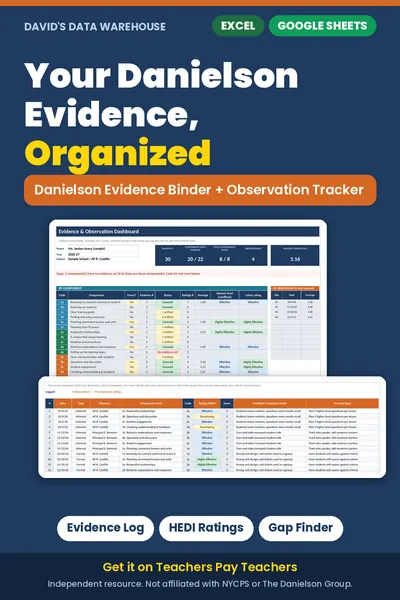
If you'd rather not build the spreadsheet yourself, the Danielson Evidence Binder & Observation Tracker ($6 on Teachers Pay Teachers) does the setup for you. It works in Excel and Google Sheets and includes:
- a Component Map of all 4 domains and 22 components with plain-language labels and evidence ideas, with a Focus column preset to the 8 NYC Advance components for SY 2025-26 (you can change it for your district),
- an Evidence Log with 300 rows, a component dropdown, and one-click links to your Drive or OneDrive files,
- an Observation Tracker for 250 component ratings with a HEDI dropdown, feedback and next steps,
- a Dashboard with a red gap list of components that have no evidence, ratings by component, a trend by observation and 3 charts,
- a Reflection & Goals tab with prompts for the IPC, a mid-year check-in and the end-of-year conference, and
- printable domain dividers plus a bonus PDF of blank dividers for a paper binder.
The averages in the file are a simple, unofficial average of the ratings you enter. They are not your official MOTP or HEDI rating. Preview images on TPT use fictional sample data.
Need to track student data too? See our guide to tracking student data in Excel. Assessment results like these make strong 3d evidence.

David's Data Warehouse is an independent, teacher-made resource shop. The Framework for Teaching is the work of The Danielson Group; Advance is the teacher evaluation system of NYC Public Schools (NYCPS). This resource is not affiliated with, sponsored by, or endorsed by The Danielson Group or NYCPS; Microsoft® Excel® is a trademark of Microsoft Corporation.